
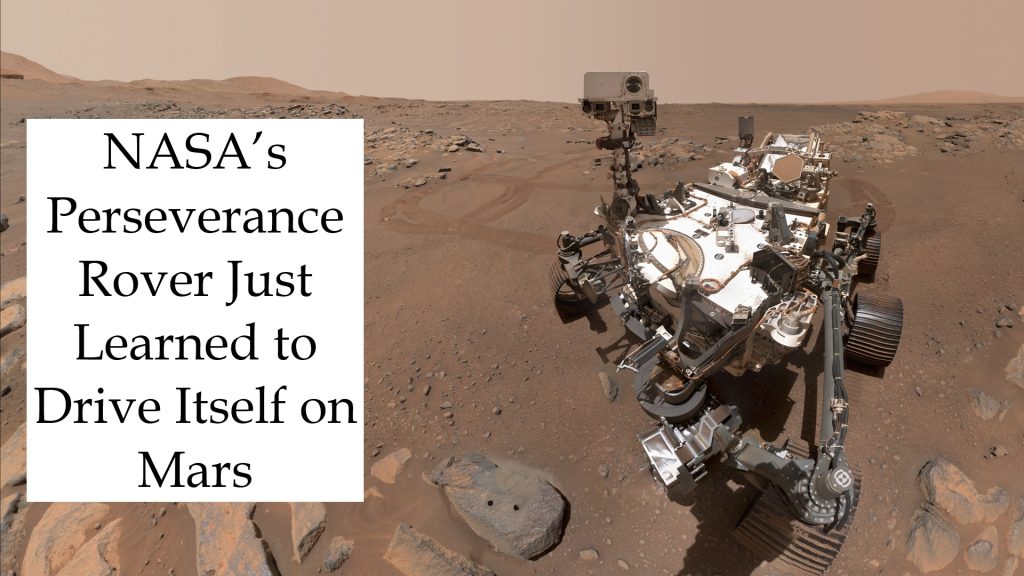
Something remarkable just happened on Mars, and it quietly marks the beginning of a new era in space exploration. NASA’s Perseverance rover completed its first ever drive planned entirely by artificial intelligence while operating on the Red Planet. No step by step commands from Earth. No waiting for human approval. Just a rover thinking, deciding, and moving on its own.
If you love space exploration, robotics, or the future of AI, you will love this update. This is not just a technical milestone. It is a preview of how future missions will explore deeper, faster, and smarter than ever before.
What Makes This Mars Drive So Important
NASA’s Perseverance rover has been navigating Mars since 2021, but until now, most of its movement relied on carefully planned instructions sent from Earth. That process works, but it is slow. Mars is far away, and communication delays mean every decision can take minutes or even hours to confirm.
This new AI powered system changes everything.
For the first time, Perseverance used onboard artificial intelligence to analyze its surroundings, map a safe route, and drive without waiting for instructions. It completed this autonomous drive in the challenging terrain of Jezero Crater, an ancient river delta believed to hold signs of past microbial life.
This capability allows the rover to cover more ground in less time, making every Martian day far more productive.
How NASA’s AI Navigation Actually Works
The technology behind this breakthrough is called enhanced AutoNav. It allows the rover to do something very human like. Look around, understand hazards, and choose the best path forward.
Here is what happens during an AI planned drive.
• The rover captures high resolution images of the terrain ahead
• AI software analyzes rocks, slopes, and potential hazards
• A safe and efficient route is calculated onboard
• The rover drives forward without stopping for Earth based commands
This process may sound simple, but on Mars it is revolutionary. The planet is filled with sharp rocks, sand traps, and uneven ground that could damage wheels or leave the rover stuck.
NASA’s engineers at Jet Propulsion Laboratory trained the system to prioritize safety while still pushing exploration forward.
Mapping Mars in Real Time With Artificial Intelligence
One of the most impressive parts of this system is how Perseverance maps its route as it moves. Using AI powered visual mapping, the rover continuously updates its understanding of the terrain.
NASA released visualizations showing how the rover builds a detailed map of its surroundings, identifying obstacles and adjusting its route on the fly. This capability allows Perseverance to drive farther per Martian day than ever before.
In previous missions, rovers often moved cautiously and stopped frequently. With AI handling navigation, Perseverance can now focus more time on science instead of waiting for instructions.
This efficiency is critical because Mars missions are limited by time, power, and hardware lifespan.
Why This Matters for the Search for Life
NASA’s Perseverance mission is not just about movement. Its primary goal is to search for signs of ancient life and collect rock samples that may one day return to Earth.
AI driven navigation helps in several key ways.
• Faster access to scientifically valuable locations
• More time spent analyzing rocks and soil
• Ability to reach areas previously considered too risky
• Improved sample collection efficiency
Jezero Crater is geologically complex. Some of the most promising areas are surrounded by difficult terrain. With AI assistance, Perseverance can reach those zones more safely and confidently.
That increases the chances of discovering clues about whether Mars once supported life.
A Glimpse Into the Future of Space Exploration
This breakthrough is not just about Mars. NASA’s success with AI navigation sets the foundation for future missions across the solar system.
Imagine missions where rovers explore icy moons like Europa or Titan, making decisions independently in environments where communication delays are even longer than Mars.
NASA’s long term vision includes human missions to Mars, and autonomous systems will play a critical role in scouting terrain, transporting supplies, and supporting astronauts before they arrive.
According to NASA, this technology also supports their broader goal of sustainable exploration, where robots can operate efficiently for years with minimal human intervention.
You can explore more about NASA’s exploration roadmap on the official NASA website at which remains the most authoritative source for mission updates and future plans.
Perseverance Is Just Getting Started
NASA’s Perseverance rover is designed for longevity. Engineers expect it to travel miles across the Martian surface over the coming years, visiting diverse geological formations and collecting invaluable data.
With AI navigation now active, the rover is ready to tackle more ambitious routes. NASA has already confirmed that Perseverance is prepared for long distance drives in the years ahead.
This means more discoveries, more samples, and a deeper understanding of Mars than ever before.
Even More Space Science Is Happening Right Now
While Perseverance continues its journey, NASA’s spacecraft are also capturing stunning images across the solar system. Recently, Mars orbiters observed Comet 3I Atlas, offering scientists a rare look at a visitor from beyond our solar neighborhood.
These observations remind us that Mars exploration is part of a much larger scientific effort. Every mission, whether robotic or observational, contributes to understanding our place in the universe.
Why This Update Feels Special
There is something deeply exciting about watching a machine think for itself on another planet. NASA’s Perseverance rover is no longer just following instructions. It is making choices, adapting, and pushing boundaries.
This update feels like a turning point. It shows how far space technology has come and hints at what is possible next.
If this is what AI can do today on Mars, imagine what tomorrow will bring.
What to Watch Next
In the coming months, expect NASA to release more data from AI assisted drives, new images from unexplored regions, and updates on sample collection efforts.
This mission is evolving, and each advancement brings us closer to answering one of humanity’s biggest questions.
Are we alone?